

Management of Impact on Stakeholders in the Value Chain

1

Value Chain and Stakeholders Identification

The Company places great importance on managing its business value chain, which serves as a key tool for enhancing competitiveness and mitigating sustainability-related operational risks. The Corporate Governance and Business Development Committee conducts an analysis of the Company’s core activities across the entire value chain, from upstream to downstream. This process includes identifying key stakeholders who are either significantly impacted by or have a business relationship with these activities. The Committee then analyzes and reviews the relationships and the positive and negative impacts of the Company's activities on stakeholders.

The insights from the value chain analysis have been used to establish management approaches for engaging with 6 stakeholder groups across the entire value chain, covering both 6 primary activities and 4 support activities. These activities include
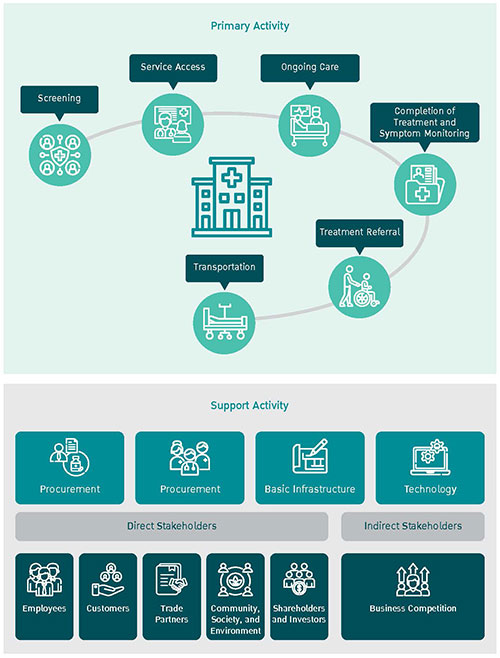
Primary Activities

  • Screening
    Screening of customers before receiving services based on standardized procedures and prioritization through medical assessment to ensure the highest treatment efficiency.
  • Service Access
    Establishing service user management standards throughout the entire service process
  • Ongoing Care
    Providing ongoing care, treatment, and services to customers by certified healthcare professionals, nurses, and other specialists throughout all hospital service processes.
  • Completion of treatment and Symptom Monitoring
  • Ensuring appropriate patient diagnosis based on health conditions, identifying treatment plans to maximize effectiveness, and collaborating with healthcare professionals or external agencies for referral when necessary.
  • Treatment Referral
    Systematic and standardized referral of treatment to certified external agencies in accordance with patients' treatment needs.
  • Transportation
    Providing high-quality and safe patient transportation services in compliance with legal standards and relevant regulations.

Support Activity

  • Procurement
    Conducting fair, transparent, and accountable procurement of medicines, medical supplies, equipment, and other necessities to ensure efficiency and compliance with established standards.
  • Human Resources
    Recruiting, managing, enhancing, and developing healthcare professionals and employees within the organization to cultivate expertise, specialization, and professionalism.
  • Infrastructure
    Designing fundamental service structures with a focus on accessibility and convenience
  • Technology
    Developing technology to enhance service delivery, ensuring accurate, prompt, convenient, and safe services for patients and customers.
2

Stakeholder Engagement

The Company has identified key internal and external stakeholders associated with its business value chain and has assessed both positive and negative impacts, as well as potential risks and opportunities, arising from its activities. This evaluation considers both actual and potential impacts on stakeholders. The Company gathers relevant issues by listening to feedback and suggestions through both formal and informal channels. These insights are then analyzed to develop strategic action plans that align with stakeholder expectations. The outcomes of this process are integrated into the Company's business strategy and operational plans, covering economic, social, human rights, and environmental aspects. The operational results for the year 2024 are as follows:

Stakeholder Engagement Promotion Channels Needs and Expectations Responses
Employees
  • Executives’ meetings with employees (townhall meetings)
  • CEO’s open letters to employees via the intranet system (weekly email from CEO)
  • Receiveopinions / recommendations and problems of employees via various online channels such as PR9 Connect LINE Group, e-mail, website, etc
  • Install red boxes for receiving problem reports
  • Surveyorganizationengagement
  • Survey safety culture
  • Personnel training and development
  • Annual performance evaluations
  • Continuous quality improvement (CQI) project proposals
  • Fair evaluations
  • Remuneration management
  • Appropriate salary and bonus adjustments
  • Job security and advancement
  • Development of skills and capabilities
  • Smooth communication and work performance
  • Safety management inside agencies
  • Continuous development of employee capabilities
  • Personnel retention
  • Respect for human rights principles
  • Compliance to labor laws
  • Review the annual performance evaluations of employees by using a performance management system (PMS)
  • Performance evaluation with 2-way communication
  • Development of plans and support for training according to plans and individualized skill, knowledge, and competency evaluation
  • Specification of job positions for advancement on the executive and operations levels
  • Improving work environment in line with occupational health and work safety principles
  • Activities to promote relationships in the organization (OD)
  • Consultation by the Human Resources Department
  • Work section meetings
  • Providing channels for reporting undesirable events and lack of work safety
Stakeholder Engagement Promotion Channels Needs and Expectations Responses
Shareholders and Investors
  • Annual general shareholder meetings
  • Opportunities for shareholders to exercise the right to nominate directors, propose meeting agendas, submit questions in advance, and express opinions and recommendations
  • Investor relations activities
  • Communication via online and printed media such as www. praram9.com, news letters, and electronic news
  • Participation in roadshow activities, and others
  • Good corporate governance and business ethics along with transparency and verifiability
  • Anti-corruption
  • Consistent remunerations from investment
  • Secure business growth and profitability
  • Risk management to prepare for changes and sustainable future business growth
  • Regular disclosures of company information
  • Systematic, concise, and thorough risk management on the economic, social, and environmental dimensions
  • Development of an effective internal control, and risk management system
  • Development of business potential for continuous growth, and long-term investment returns
  • Business operation under good, transparent, and fair corporate governance principles
  • Disclosing and presenting performance, direction and plans correctly, completely, transparently, and in a verifiable manner
  • Updating the investor relations website for it to be current and complete and listening to opinions and recommendations
Stakeholder Engagement Promotion Channels Needs and Expectations Responses
Customers
  • Patient experience surveys in receiving service.
  • Surveys of needs, satisfaction, and service recommendations from the contact center system.
  • Customer relations activities/marketing activities to continuously meet with customers.
  • Creating 24-hour contact channels via the 1270 telephone number or the website at www. praram9.com.
  • Participation in community and social development
  • Developing services according to the standards and expectations of customers.
  • Medical expertise.
  • Promoting family engagement in treatment planning.
  • Clear communication about treatment and practices after returning home.
  • Convenient and effective access to treatment services.
  • Responsibility to service recipients
  • Receiving correct and fast medical treatment information.
  • Appropriate medical treatment expenses
  • Developing innovations and cooperation by using digital technology to enhance services
  • Developing and improving service treatment processes to be effective and promoting patient and family engagement in addition to effectively and continuously communicating care and treatment
  • Providing standard medical services according to international standards in line with regulations and laws
  • Estimating medical treatment prices reasonably
  • Adjusting medical treatment expenses in different packages
  • Increasing service access channels via social media
  • Development of the 9 CARE platform innovation to provide care for patients with chronic, challenging, or complex diseases continuously at home connecting health information to the family members of patients
Stakeholder Engagement Promotion Channels Needs and Expectations Responses
Community and Society
  • Surveying community needs
  • Meetings, visits, and conversations
  • Website and online social media
  • Receiving opinions and complaints via various communication channels such as the 24-hour 1270 hotline or the hospital’s website
  • Participation in improving the quality of life of communities and society
  • Worthwhile utilization of resources
  • Supporting for the use of clean energy
  • Reduction of greenhouse gas emissions
  • Reducing impacts from climate change
  • Energy conservation
  • Water and waste management
  • CSR activity in the “Chum Chon Mi Suk” project
  • Creation of learning media and health news that are modern and meet social media needs
  • Development of effective and modern services in line with the needs of members of society in every age group in order to promote good quality of living for people in society
  • Promoting and campaigning for efficient resource utilization according to the 3Rs principle
Stakeholder Engagement Promotion Channels Needs and Expectations Responses
Trade Partners
  • Selecting and assessing the performance of trade partners by at least once annually
  • Identifying important trade partners by dividing them into those that directly conduct business with the Company and those not conducting business directly with the Company
  • Holding meetings, seminars, and activities
  • Annual visits to trade partners
  • Projects/activities to develop business jointly with trade partners
  • Receiving opinions and recommendations via postal service and the Company’s website addressed to the Audit Committee
  • Communication via electronic media and telephone
  • Transparent and fair procurement with emphasis on equality
  • Fast procurement process
  • Fair and punctual payment of remunerations
  • Compliance with trade conditions and contract compliance and making payment according to conditions
  • Respect for human rights and fair treatment of workers with responsibility for society and the environment
  • Development of skills and capabilities of trade partners
  • Holding trade partner meetings, entering in to purchase-sales and procurement contracts, and treating all trade partners equitably and fairly according to the procurement policy
  • Supply chain management
  • Human rights due diligence (HRDD) surveys covering trade partner employees
  • Providing training for trade partners’ employees who are working in the hospital in the same manner as the hospital’s permanent employees
Stakeholder Engagement Promotion Channels Needs and Expectations Responses
Competitors
  • Meetings of the Private Hospital Association
  • Operate within the good and generally-accepted rules for competition
  • Avoid buying the personnel of competitors
  • Follow the organization’s ethics policy, and trade agreements
  • Follow the Business Code of Conduct
  • Attend meetings of the Private Hospital Association, provide information and recommendations, and adhere to and cooperate according to meeting resolutions