

Governance and Economy
Business Ethics, Integrity, and Transparency
Corporate governance and economic issues are key dimensions of sustainability that attract public interest. The Company has established Corporate Governance Policy and Business Code of Conduct, including a clearly documented anti-corruption policy. Effective corporate governance is a critical factor in enhancing operational efficiency and achieving business objectives. Therefore, the Company places great importance on conducting business with transparency, fairness, and ethics in accordance with good corporate governance principles. This approach ensures respect for human rights across all stakeholder groups, supply chain management, stakeholder responsibility, and risk management. Additionally, the Company integrates information technology into service development while ensuring data security and privacy to enhance customer satisfaction and trust, ultimately strengthening long-term competitiveness.
The Company has participated in the Corporate Governance Report of Thai Listed Companies 2024 (CGR) marks the 6th year of evaluation, organized by the Thai Institute of Directors Association (IOD), with the support of the Stock Exchange of Thailand (SET). This reflects the Company’s strong commitment to good corporate governance under corporate governance principles, vision, and sustainable management, while considering the roles of stakeholders and ensuring fair treatment of shareholders.
Goals
- Maintain Corporate Governance Rating (CGR) at an excellent level.
- Executives' adherence to the Business Code of Conduct 100%.
Performance Results

The Company has been assessed in the Corporate Governance Report of Thai Listed Companies 2024: CGR, achieving a 5-star rating or the “Excellent” (Excellent CG Scoring) standard. This recognition has been maintained since the first year of its listing on the Stock Exchange of Thailand, continuing for 6 consecutive years. Additionally, the Company has been ranked in the Top Quartile among all listed companies, the service sector, the Market Cap. > Baht 10,000 million group, and the market/index category.
Anti-Corruption
The Company has established a clear and documented Anti-Corruption Policy to ensure that business operations are conducted with transparency, ethics, and adherence to good corporate governance principles. The Company is committed to complying with all relevant laws and regulations related to anti-corruption and bribery prevention, including the giving or receiving of bribes involving government officials or the private sector. To reinforce this commitment, the Company has structured its organizational framework with clearly defined roles, responsibilities, workflows, and reporting lines within each department. This structure ensures checks and balances, enhances accountability, and facilitates rigorous internal oversight to prevent corruption effectively.
Additionally, the Company actively communicates and conducts training programs to raise awareness on this matter. The training is structured into 2 formats: Induction training for new employees during their orientation day. Annual training for employees and executives as a refresher to reinforce knowledge and understanding. The training is conducted using a Hybrid learning classroom model, combining both in-person sessions and online learning. Employees also have access to E-learning resources for continuous education. Furthermore, the Company has developed and implemented a Supplier Code of Conduct and Guideline, serving as a framework for responsible business practices within the supply chain.
In every Audit Committee meeting, the Company includes an agenda item requiring the management team to report on the summary of reported violations of the Code of Conduct and corruption incidents, as well as the Company’s response and handling process. Following this, the report is subsequently submitted to the Board of Directors for further review.
Goals
- The Company has been continuously certified as a member of the Thai Private Sector Collective Action Against Corruption (CAC).
- At least 2 suppliers will declare their commitment to joining the Thai Private Sector Collective Action Against Corruption by the year 2025.
- 100% of executives and employees acknowledge the anti-corruption policy.
Performance Results
The Company has been certified as a member of the Thai Private Sector Collective Action Against Corruption or ThaiCAC (CAC), under the Thai Institute of Directors Association, on an ongoing basis.
Supply Chain Management
The Company is committed to conducting business with responsibility, integrity, transparency, and fairness, based on good corporate governance and ethical business practices. The Company has established five strategic approaches for supply chain management: Demonstrating commitment to sustainable supply chain governance and communicating with key suppliers to sign the Code of Conduct and join CAC. Developing the business supply chain by identifying customer groups and conducting an annual supplier evaluation. Collaborating with suppliers to ensure the quality assurance of pharmaceuticals and medical supplies throughout the supply chain. Complying with sustainability guidelines by assessing potential risks among suppliers in accordance with ESG. Ensuring transparency and accountability by openly disclosing information to all relevant stakeholders.
The Company has established a Supplier Code of Conduct to serve as a guideline for fostering sustainable business practices between the Company and its suppliers. This ensures transparency, respect for human rights, fair labor practices in compliance with legal and ethical standards, adherence to occupational health, safety, and environmental regulations, and strict performance monitoring, as follows:

Suppliers must deliver high-quality goods and services, at fair and reasonable prices, ensuring accuracy, completeness, and timeliness. They must continuously improve their products and services using modern technology.

Suppliers must comply with the law, respect intellectual property rights, and implement measures to protect the Company’s confidential information. They must not use critical business information without the Company's explicit written consent, including any confidential information related to the Company or its stakeholders.

Suppliers must treat all stakeholders responsibly and fairly, ensuring equal opportunities in competition. They must also conduct business with integrity and in accordance with fair competition principles.

Suppliers should use resources efficiently to minimize waste, prioritize environmentally friendly products or production methods, and ensure their operations do not negatively impact the environment. They should also encourage employees to use environmental resources responsibly and efficiently.

Suppliers must comply with labor laws and treat all employees equally, without discrimination. They must not engage in illegal labor practices or forced labor, including human trafficking and child labor. Comprehensive human rights risk assessments must be conducted to cover all employees working for suppliers (Human Rights Due Diligence: HRDD).

Suppliers should conduct business with consideration for the impact on the community and society, actively contributing to improving quality of life and well-being. They must also monitor and mitigate any business activities that could negatively affect communities.

Suppliers must comply with environmental laws, including pollution control and waste management, while developing sustainable business processes. This includes implementing measures to reduce greenhouse gas emissions, such as improving production processes.

Suppliers have the right to inquire, report, or file complaints regarding any violations of Praram 9 Hospital’s business ethics. Complaints can be submitted via email at CEOoffice@praram9.com or by directly calling senior executives at 087-111-5994.
Remarks : Supplier Assessment Data (QF-MPS-20/Rev.01)
Supplier Selection and Evaluation
- New Supplier Selection
The procurement officer is responsible for sourcing new suppliers who are expected to meet the Company's requirements for delivering goods or services. These suppliers must be verifiable in various aspects, including product/service quality, the Company's receipt standards, legal compliance, personnel, financial status, product delivery, after-sales service, environmental considerations, and more. Additionally, they must undergo evaluation based on the criteria outlined in the vendor selection form// subcontractor selection form(QF-PUR-03/Rev.15). - New Supplier Registration
Suppliers must submit the required documents for new vendor registration, including a copy of the Company's certificate of incorporation, a copy of the P.P.20 form, a list of reference customers, certificates of compliance with various standards, a company location map, a copy of the bank account details, and other necessary documents. Once the new vendor meets the minimum evaluation criteria and receives - Sign and acknowledge.
All new suppliers must conduct a self-assessment in the vendor selection / subcontractor selection form and acknowledge their commitment to the anti-corruption initiative (Change Agent), as well as adopt environmentally friendly procurement and sourcing practices. - Performance evaluation.
The Company will conduct an annual evaluation of its key suppliers and perform random on-site assessments at their facilities based on the Company's established criteria. Additionally, suppliers are required to conduct a self-declaration annually, covering environmental, social, and governance (ESG) aspects in the vendor assessment form.
Identification of Critical Supplier
The Company has established criteria for identifying critical suppliers to analyze and develop appropriate strategies, as well as to assess risks to enhance procurement efficiency.
- Key suppliers that directly engage with the Company (Critical Tier 1) are identified based on essential product and service categories.
- General products and services: Selected based on the highest transaction volume each year, limited to 15 suppliers.
Onsite assessment at operational locations (Onsite) by randomly selecting critical suppliers or those with procurement-related issues. - Pharmaceuticals and medical supplies: Selected based on the highest transaction volume each year, limited to 15 suppliers.
Onsite assessment at operational locations by randomly selecting key suppliers or those with procurement-related issues.
- General products and services: Selected based on the highest transaction volume each year, limited to 15 suppliers.
- Key suppliers that do not directly engage with the Company (Critical Non-Tier 1) are selected from those supplying goods and services to critical suppliers.
Trade Partner Management
The Company prioritizes supplier development and management to ensure alignment in compliance with regulations and sustainable business operations. Key and general suppliers are assessed at least once per year according to the supplier development and performance enhancement plan, aiming to reduce risks and create sustainable competitive advantages, as follows:
1. Key suppliers must be evaluated at least once per year.
Criteria for Identifying Critical Suppliers
- 1.1 Suppliers providing pharmaceuticals, medical materials, or continuous product and service supply to the Company.
- 1.2 Suppliers involved in high-value or high-volume procurement.
- 1.3 Suppliers that are limited in number and provide goods or services that are difficult to replace.
Key Supplier Screening Results for the Year 2024
| Supplier Screening | Unit | General Procurement | Pharmaceuticals and Medical Supplies Procurement |
|---|---|---|---|
| Total Number of Suppliers | Suppliers | 354 | 527 |
| Number of Critical Suppliers Directly Doing Business with the Company (Critical Tier 1) | Suppliers | 15 | 15 |
| Total Procurement Value of Goods and Services | Million | 477.2 | 673.3 |
| Total Procurement Value of Goods and Services Critical Suppliers Directly Doing Business with the Company | Baht | 255.0 | 274.8 |
| Proportion of Procurement Value from Critical Suppliers Directly Doing Business with the Company | % | 53.43 | 40.83 |
| Number of Suppliers Indirectly Doing Business with the Company | Suppliers | 45 | 45 |
| Number of Critical Suppliers Indirectly Doing Business with the Company (Critical Non-Tier 1) | Suppliers | 15 | 15 |
2. Supplier Risk Assessment Criteria
Supplier Evaluation Criteria
- 2.1 Service (Speed / Timeliness / Customer Satisfaction / Ease of Contact)
- 2.2 Product / Service Delivery
- 2.3 Product / Service Quality (Supporting Documentation / Pricing)
- 2.4 After-Sales Service
- 2.5 Compliance with the Supplier Code of Conduct
- 2.6 Consideration of Environmental Standards
- 2.7 Consideration of Social and Community Standards
- 2.8 Equal Labor Treatment and Prohibition of Child Labor
3. Hospital Supplier Evaluation Results in 2024
Annual Supplier Assessment Results, Evaluating Supplier Operations within the Supply Chain for the Year 2024, with Most Suppliers Achieving an A Rating Across Both the Pharmaceutical and Medical Supplies Category and the General Goods Category.

4. Suppliers Have Acknowledged and Signed Acceptance of the Business Supplier Code of Conduct, Particularly Regarding Anti-Corruption Policies for the Years 2022 - 2023
| Number of Suppliers | Unit | General Procurement | Pharmaceuticals and Medical Supplies Procurement |
|---|---|---|---|
| Number of Suppliers Covered and Communicated Regarding the Business Supplier Code of Conduct | Suppliers | 400 | 10 |
| Number of Suppliers Who Signed Acceptance of the Business Supplier Code of Conduct | Suppliers | 18 | 10 |
| Proportion of Suppliers Who Signed Acceptance of the Business Supplier Code of Conduct | % | 4.5 | 100 |
Year 2024 Implementation to prioritize responses for key suppliers and all new suppliers (Effective from November 1, 2024)
| Number of Suppliers | Unit | General Procurement and Pharmaceuticals & Medical Supplies Procurement |
|---|---|---|
| Number of Critical Suppliers Communicated Regarding the Business Supplier Code of Conduct | Suppliers | 30 |
| Number of Critical Suppliers Who Signed Acceptance of the Business Supplier Code of Conduct | Suppliers | 30 |
| Proportion of Critical Suppliers Who Signed Acceptance of the Business Supplier Code of Conduct | % | 100 |
| New Suppliers in 2024 Registered According to the Specified Criteria and Meeting the Selection Standards for Sustainability, Quality, Environment, and Safety | Suppliers | 113 |
| Number of New Suppliers Who Signed Acceptance of the Business Supplier Code of Conduct | Suppliers | 18 |
| Proportion of New Suppliers Who Signed Acceptance of the Business Supplier Code of Conduct | % | 15.9 |
Remarks: Form Update (QF-PUR-03/Rev.15) on November 1, 2024
5. At least2 suppliers will declare their commitment to joining the Thai Private Sector Collective Action Against Corruption by 2025
Action Plan
- Communicate with suppliers in 2023-2024
- Foster collaboration by having suppliers acknowledge and commit to joining the Thai Private Sector
Trade Credit Payment Policy
- The determination of trade credit payment terms (Credit Term) with suppliers is specified during the evaluation and selection process for new vendors / subcontractors. A standard credit payment term of 30-60 days has been established. If a supplier proposes a credit payment term shorter than the standard criteria, additional consideration should be given in cases where the goods are urgently required or are specifically essential for service provision. Additionally, credit payment terms should be reviewed when purchase volumes increase. There may also be an opportunity for cash discount based on mutual agreements with the accounting department.
- Payments shall be made in accordance with the accounting department's established guidelines. Payments shall be made in accordance with the specified trade credit payment terms (Credit Term) or as stated in the contract. The cut-off date for delivery notes or invoices is set on the 25th of each month.
Funds will be transferred on the 1st banking business day of each month. Suppliers can verify payment transactions via the E-mail provided to the Hospital.
Average Trade Credit Payment Period in 2024 = 30 days
Supplier Communication, Employee Training, and Supplier Programs
Security Personnel Training
The Company remains committed to ensuring effective security measures while strictly adhering to human rights principles in handling unsafe incidents. The Company has conducted training on its organizational human rights framework for security personnel, covering 100% of all security staff, totaling 73 personnel (41 personnel in Building A and 32 personnel in Building B). The training comprehensively addresses key topics aligned with the Company's core human rights policy, ensuring strict compliance.
Environmental Training
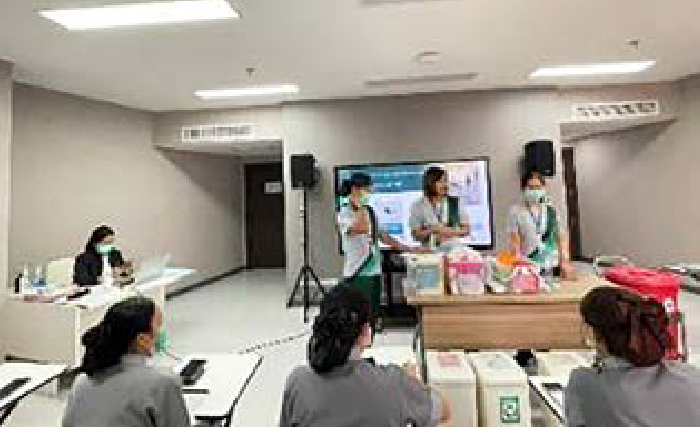
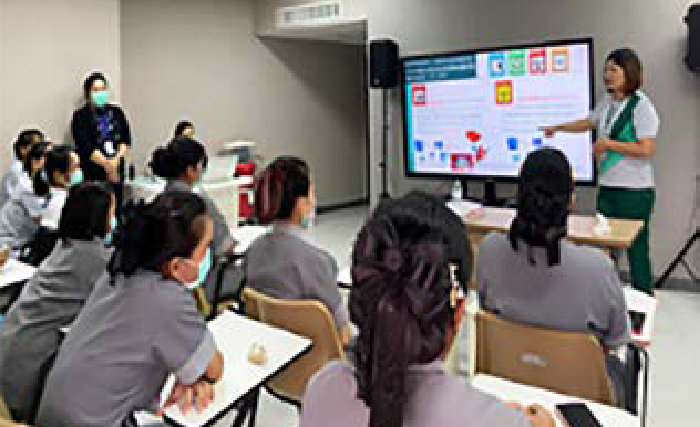
The Safety Week training placed special emphasis on environmental issues, aligning with the new JCI standards. The program focused on educating and raising awareness about proper waste management and waste segregation by category to reduce environmental impact and promote a healthy workplace environment. Additionally, all personnel were invited to participate, with a particular emphasis on the housekeeping team, achieving 100% participation from all 109 housekeeping staff (including 29 in-house employees and 80 contract housekeeping staff). The training ensured a thorough understanding and consistent implementation of waste management guidelines. Upon completion, all participants were able to systematically apply their knowledge to daily operations, strengthening the Company’s safety and environmental standards for long-term sustainability.
Collaborative Projects with Suppliers
1. Akkhie Prakarn Public Company Limited
For the collection and transportation of hazardous and chemical waste, the Hospital has collaborated with Akkhie Prakarn Public Company Limited to transition from foam packaging to carton boxes (Reuse), with clear waste type labeling. This initiative aims to reduce foam usage and improve transportation efficiency. The number of boxes has been calculated based on vehicle capacity and total weight, ensuring it does not exceed 500 kilograms per trip. As a result, the frequency of waste collection rounds has been significantly reduced, leading to lower transportation costs per round. Additionally, unused foam previously used for waste containment has been repurposed into planters for growing plants, further reducing waste and promoting efficient resource utilization.


2. ANC International (Thailand) Company Limited
The bottled drinking water manufacturer under the Hospital's brand has implemented the following improvements:
- 2.1 Installation of Solar Rooftop on the Factory Roof with a Total of 120 Panels, Capacity of 65.40 KW, Contributing to an Average Monthly Reduction in Electricity Costs of Over 30,000 Baht in cost savings and a reduction in carbon dioxide emissions and other greenhouse gases released into the atmosphere. This initiative contributes to mitigating Global Warming and addressing the crisis of Climate Change.
- 2.2 Electric Vehicles have been introduced for product delivery to customers. This initiative reduces diesel consumption, lowers the Company’s expenses, and contributes to mitigating global warming.
3. Nature Touch International Company Limited
Manufacturer of Admission Set for the Hospital’s inpatient ward, with the following process improvements:
- 3.1 Replaced aluminum toothpaste tubes with 100% recyclable tubes, adopting sustainable and environmentally friendly packaging.
- 3.2 The toothpaste formula has been adjusted to contain more than 10 herbal extracts and natural essential oils, reducing the use of chemicals.
Supplier Satisfaction Evaluation on Collaboration with the Procurement Department Results of the Supplier Satisfaction Assessment on Collaboration with the Company’s Procurement Department in 2024 The Company conducted a supplier satisfaction survey for pharmaceuticals, medical supplies, general goods, and service categories, distributing the assessment to suppliers in these areas. The assessment covered various aspects, including the knowledge and competency of procurement personnel, confidentiality in handling supplier information, fairness and non-discrimination in procurement practices, provision of information on the Supplier Code of Conduct and compliance with the Company’s Anti-Corruption Policy, efficient resource utilization, environmental considerations, and openness to feedback and suggestions for continuous improvement. The overall supplier satisfaction score was above 95%, reflecting a high level of satisfaction.
Supplier Satisfaction Assessment Results 2024

Innovation and Collaboration
SMART HOSPITAL
Praram 9 Hospital has developed the Smart Hospital project, integrating multiple technologies to enhance service delivery across all dimensions. This initiative aims to meet the needs of patients in the digital era by providing convenience, speed, and data security, creating a new healthcare experience. One of the key challenges in implementing the Smart Hospital project is not only the development of the Smart Hospital system itself but also the integration of previously implemented sub-projects to ensure seamless and efficient operation. This requires advancements in data management and technology, which are inherently complex and highly sensitive.
Objectives
- Enhancing the efficiency of medical services
- Reducing patient waiting times
- Streamlining processes and eliminating redundancy in service systems
- Increasing patient satisfaction
- Reducing staff workload and minimizing errors in document-based processes
- Promoting a secure and standardized health information management system
- Developing a system that accommodates a wide range of users across all age groups
Main Concepts of Smart Hospital
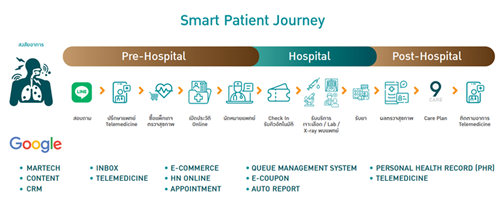
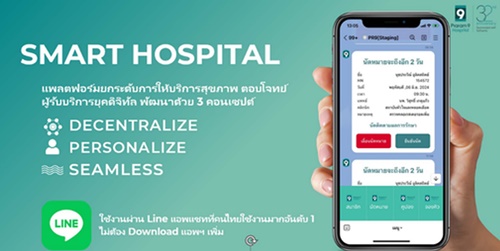
The Smart Hospital project has been developed based on three core concepts::
- Decentralize: Expanding healthcare services to cover both pre-hospital and post-hospital care
- Personalize: Focusing on personalized data storage and communication to deliver services tailored to the needs of patients
- Seamless: Creating a seamless service experience by integrating service data between online platforms and in-hospital services
Development Plan for System and Key Functions
- Digital System and AI Development
1.1. New Hospital Information System (HIS) that integrates all processes
1.2. Implementation of AI Screening
1.3. AI Assistant to provide patient guidance and support healthcare professionals
- Services via LINE Super App The Smart Hospital service has been developed for accessibility through the LINE application, the most widely used platform in Thailand. This integration eliminates the need for users to download additional applications, allowing them to conveniently access services via the Hospital’s LINE Official account.
- Key Functions of Smart Hospital
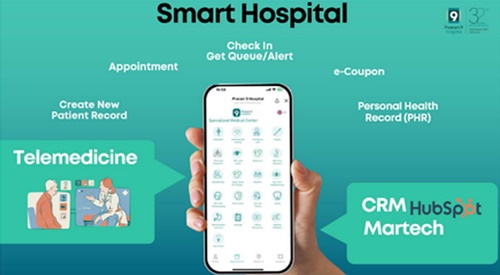
3.1. Create New Patient Record: New patients can register online and receive an automatic queue number when seeking services, reducing waiting time and redundant procedures.
3.2. Appointment Management : Patients can schedule, reschedule, or cancel appointments on their own through the Smart Hospital system, while also checking physician information and consultation schedules.
3.3. Check In & Get Queue/Alert: Mobile Check-in and Real-time Service Route Notifications, including service point locations and queue status updates.
3.4. Coupon and Benefit Management: Check health coupon eligibility and redeem accumulated points for discounts or complimentary gifts.
3.5. Access to Personal Health Record (PHR): View lab results, X-ray reports, medication history, and vaccination records.
Benefits for Patients
- Reduced waiting times and fewer required hospital visits.
- Ability to manage appointments independently.
- Real-time notifications throughout the service process.
- Access to personal health records anytime, anywhere.
Benefits for Healthcare Professionals
- Reducing paperwork and minimizing errors in data entry
- Enhancing patient care efficiency
- Decreasing congestion in service areas, such as registration points and examination rooms
- Providing more time for health consultations with patients
Positive Impacts
- Enhancing staff efficiency and reducing operational costs
- Increasing revenue from online services such as Telemedicine and health checkup packages
- Strengthening the Hospital’s reputation as a leading digital healthcare provider
- Attracting new patients through referrals and system convenience
Opportunities
- Expanding Smart Checkup and Telemedicine services to corporate clients
- Developing AI and Machine Learning to enhance diagnostic accuracy
- Building an integrated health information system with partner hospitals
Risks
- Challenges in transitioning to a digital system, which may cause delays in implementation
- Data security risks (Cybersecurity) requiring stringent management
- Difficulties in adapting for both medical staff and elderly patients to the new system
Goals
- Patient Satisfaction
- Increase in new patients (New HN)
- Enhanced operational efficiency and cost reduction
- Increased revenue from online services
Project Implementation Timeline
- 2022: CEO announces the goal of Smart Hospital
- 2023: Digital Transformation and the launch of Lean & Smart Check-Up
- 2024: Development of IT Infrastructure and deployment of AI-Driven Hospital
- 2025: Fully Operational Smart Hospital
The Smart Hospital project integrates technology and innovation to enhance medical services, improving convenience, safety, and efficiency. This initiative not only benefits patients but also optimizes work processes for medical personnel and strengthens the Hospital’s competitive advantage in the digital era.
9 CARE Platform and 9 CARE Shop
Currently, medical services are transitioning into the era of Digital Hospital and Decentralized Health Care, focusing on comprehensive healthcare through digital technology. To align with this trend, Praram 9 Hospital has developed 9 CARE Platform and 9 CARE Shop to enhance medical service efficiency through digital technology. This includes 9 CARE Application and 9 CARE Shop, enabling patients to easily access medical services while ensuring closer, safer, and more convenient patient care.
Objectives of the Development Project
- Developing the 9 CARE Platform into a modern Telemedicine system, integrating health data through IoT devices and supporting comprehensive medical services via digital technology.
- Enhancing Access to Medical Services by improving service delivery, allowing patients to consult with physicians anytime, anywhere, without the need to visit the Hospital.
- Promoting the Use of Health Technology through Smart Health Devices and Medical IoT, ensuring effective home healthcare management.
- Developing the 9 CARE Shop as a central hub and medical equipment distribution channel, seamlessly connected to the 9 CARE Platform, facilitating patient convenience and addressing the growing demand for home healthcare solutions.
2.1 9 CARE Application is a Telemedicine Platform that enables patients to consult with physicians via real-time video calls, allowing healthcare professionals to diagnose and provide medical advice without requiring in-person visits, thereby reducing time and location constraints. Additionally, the system supports Personalized Healthcare Management (Personal Care Plan), where physicians collaboratively design customized healthcare plans tailored to individual needs. The system also enables real-time health data sharing with the patient's family, ensuring seamless and effective caregiving. A team of professional nurses continuously monitors patient conditions through Medical IoT, which tracks key health indicators for efficient and proactive healthcare management, such as
- Blood Pressure Monitor
- Blood Glucose Monitor
- Body Temperature Monitor
- Weighing Scale
- Smart Watch for real-time health tracking
Development Plan for 9 CARE Platform
📌 Expanding Telemedicine 24-Hour Services
- Enabling patients to consult physicians via video calls anytime, anywhere.
- Supporting both domestic and international patients without Time Zone issues.
- Expanding the team of specialized physicians to be available 24/7.
📌 Personal Care Plan & Medical IoT
- Developing personalized health plans in collaboration with physicians and nurses.
- Integrating medical devices such as blood pressure monitors, blood glucose monitors, and Smart Watch for continuous health monitoring.
📌 Enhancing Online Medical Certificates (e-Medical Certificate)
- Developing a standardized electronic medical certificate system.
- Ensuring compatibility with Telemedicine services and in-hospital treatments.
Health Insurance Eligibility Check Feature
- Adding a function in the 9 CARE app, allowing users to verify their health insurance coverage.
2.2 9 CARE Shop has been developed as a medical equipment distribution channel that seamlessly integrates with 9 CARE Platform to support home healthcare. It focuses on real-time health monitoring devices, enhancing the efficiency of patient care and health management.
Development Plan for 9 CARE Shop
📌 Expanding Product Offerings: Medical Devices & Smart Health Devices
- Expanding the range of medical devices, such as blood pressure monitors and thermometers, with the capability to integrate health data with the 9 CARE application.
- Adding new devices based on physician recommendations, such as nebulizers.
📌 Launch Promotional Campaigns to Encourage the Use of Smart Watches
- Introducing new features such as electrocardiogram (ECG) monitoring (ECG).
- Launching special promotions in collaboration with hospitals.
📌 Developing Service Access via Line OA: Praram9V
- Providing Guidance and After-Sales Service for Medical Devices
- 24/7 support for inquiries regarding health data and medical device usage.
Positive Impacts: Business Opportunities
- Expanding Customer Base - Patients can access medical services more conveniently from anywhere, helping to grow the customer base, especially among those unable to visit the Hospital physically.
- Generating Revenue from New Services
- Telemedicine - Creating a revenue stream through online consultations.
- Medical IoT & Smart Devices - Increasing business opportunities by selling health-related devices via 9 CARE Shop.
- Personal Care Plan - Offering an additional service that strengthens customer engagement and ensures long-term revenue growth.
- Enhancing Efficiency and Reducing Operational Costs
- Enhancing Corporate Image in Innovation and Digital Healthcare and respond to the trends of Smart Hospital and Personalized Healthcare
Negative Impacts : Potential Risks
- Data Privacy & Security Risk
- Technology & System Maintenance Risk
- Adoption & Usability Risk
- Market Competition Risk (Market Competition Risk) The Digital Health market is highly competitive. Other Telemedicine platforms may have advantages in terms of pricing or a broader network of medical professionals.
- Regulatory & Compliance Risk
Goals
- Increasing the adoption rate of Telemedicine services within the Hospital.
- Expanding the user base of 9 CARE Application.
- Boosting sales of 9 CARE Shop and encouraging the use of Smart Health Devices in conjunction with the platform.
- Developing an efficient e-Medical Certificate system and Health Insurance Eligibility Verification System .
- Creating Line OA: Praram9V is a post-sales customer service channel providing issue reporting and consultation support 24 hours a day.
The 9 CARE Platform and 9 CARE Shop projects represent a significant step for Praram 9 Hospital in advancing Digital Health, enabling patients to access medical services anytime, anywhere. These initiatives also promote the adoption of medical technology to enhance the quality of life for patients.